WoW: Forever Had the Biggest Launch in WoW History. December 9 Decides What It Means
Published 7 min read
For a decade, "Classic+" was the thing World of Warcraft players asked for and Blizzard never shipped: the original 2004 Azeroth, with its rules and its pace intact, but with new content built on top instead of the same old content replayed. On November 4, Blizzard finally shipped it. It's called World of Warcraft: Forever, and by Blizzard's own account it is the biggest launch the game has ever had.
That claim deserves a closer look. So does the more interesting question underneath it: what happens to a launch like this once the launch is over?
What Blizzard actually shipped
The first thing to understand about Forever is what it isn't. In the BlizzCon 2026 panel recap, Blizzard was blunt: "This is not a mode, a season, or a new version of Classic." Forever is a third, permanent version of the game, sitting alongside modern World of Warcraft and WoW Classic rather than replacing either.
Here is what was in the box on day one, per Blizzard's launch announcement and pre-launch overview:
- A hard level cap of 60. Blizzard says the game "sticks to a level cap of 60 without going beyond", so the plan is to grow the world sideways instead of upwards.
- More than 1,000 new quests across new and reimagined zones, including Mount Hyjal, Shen'dralas, the Riverglades and Zephras Isle.
- Nine new five-player dungeons spread from level 13 to 60, plus a new 15v15 battleground on the Darkspear Islands.
- A new race, the Skyborne, playable on either faction, along with new race/class pairings like Undead Paladin, Dwarf Shaman and Orc Mage.
- No flying and no level scaling. The world stays dangerous and zones stay tied to levels.
- Rulesets instead of realms: Normal, PvP, Roleplay or Roleplay-PvP, with Hardcore promised for later.
Access is included with a regular WoW subscription or Game Time. The Skyborne race and its starting zone sit behind the Skyborne Heroic Pack or higher, which is the one paywall worth knowing about before you install.
The one thing missing at launch was raids. Barrow Deeps (10 players), Hyjal Summit (20) and a 40-player Onyxia's Lair unlock on December 9, and that date matters more than any of the launch numbers.
"The biggest launch in WoW history"
Two days after launch, the official Warcraft account posted that Forever had achieved "the biggest launch in WoW history by peak concurrent players" and "the highest number of returning players in WoW history." Executive producer Holly Longdale added that the team was "seeing the most NEW players for a WoW launch in 15 YEARS."
Two caveats before anyone treats that as settled:
- There are no numbers attached. Blizzard hasn't published subscriber or concurrency figures in over a decade, and the launch posts don't break that habit. "Biggest launch" is a ranking without a scale.
- The comparison some outlets ran with, "bigger than Wrath of the Lich King", isn't in Blizzard's post. Blizzard said "biggest launch in WoW history". It didn't name an expansion to beat.
None of this makes the claim false. A permanent vanilla-style world with fresh content, included in the subscription most lapsed players already understand, is close to the ideal re-engagement product. But it means the evidence for how Forever is doing has to come from somewhere other than Blizzard.
What the public signals show
WoW isn't sold on Steam and Blizzard doesn't publish a player counter, so there is no direct measurement of Forever's population. That's why its page on MMOStats carries no player estimate. We only estimate when we have real signals to anchor to. What we can measure is attention.
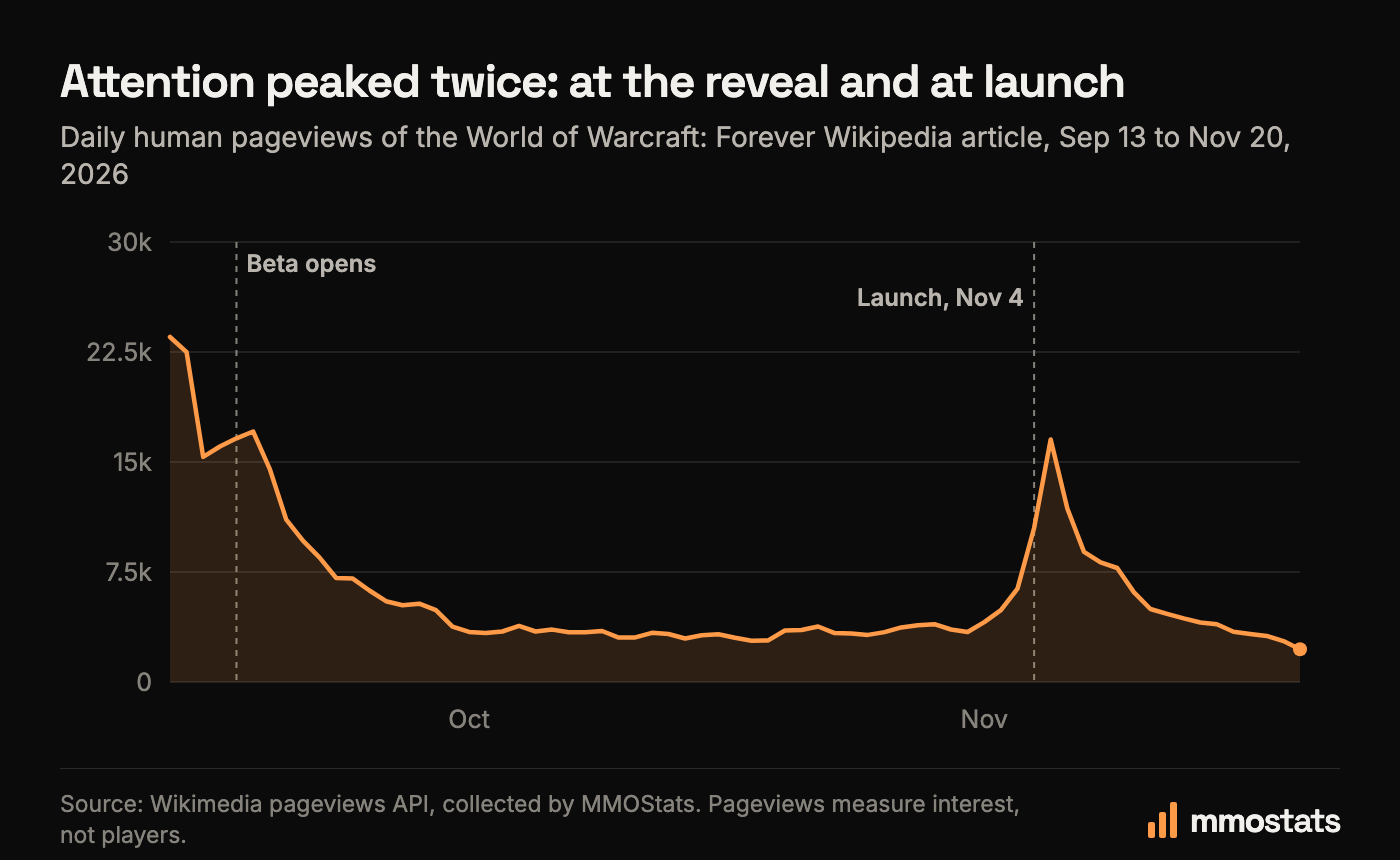
The Wikipedia article for Forever tells a two-act story. The BlizzCon reveal drove more than 23,000 views a day, followed by a long, flat plateau around 3,000 a day through October while the beta ran. Launch brought a second spike to 16,500 on November 5. By November 20, daily views were back to about 2,200, below the pre-launch plateau.
Twitch shows the same shape, with sharper edges:
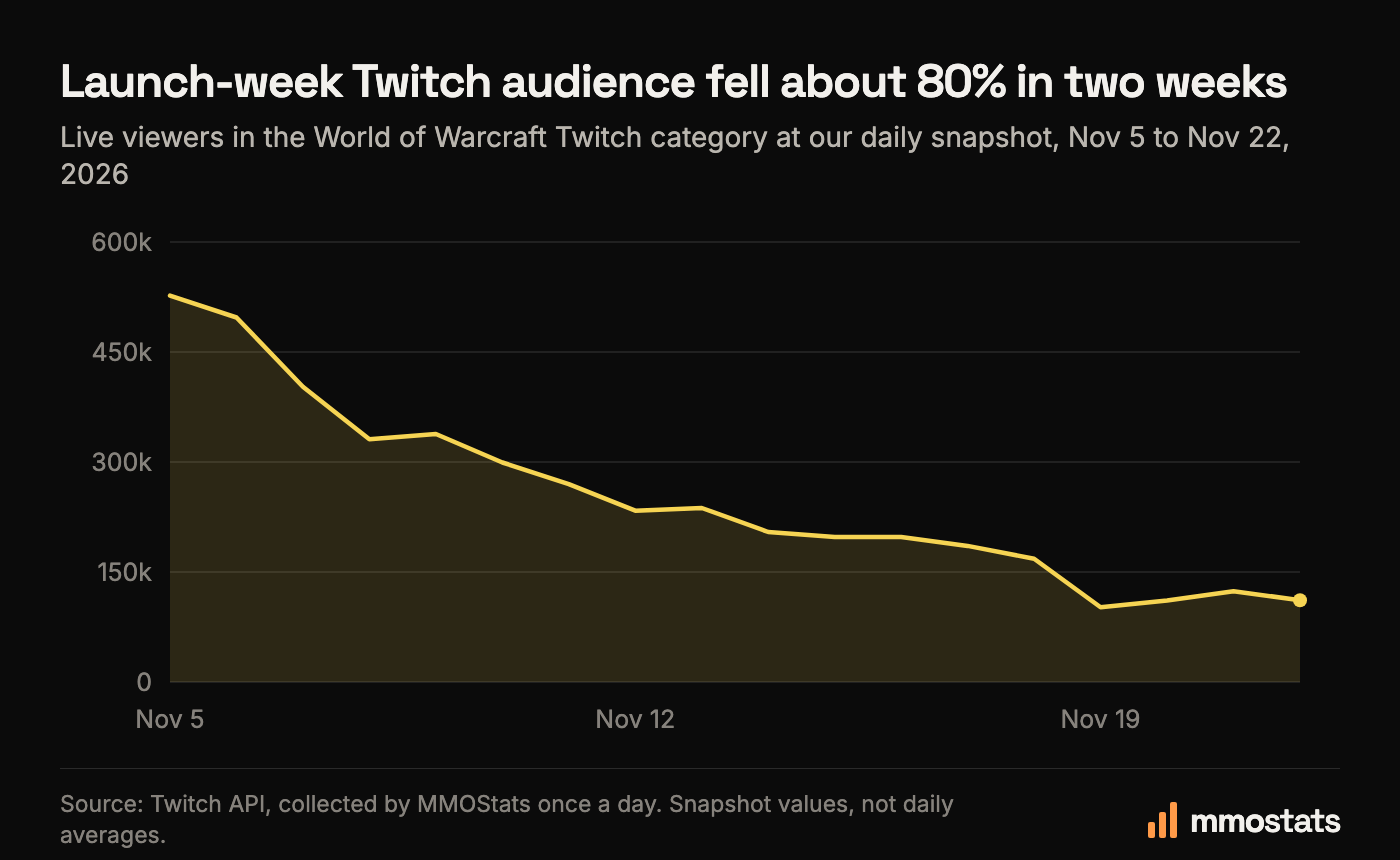
Our daily snapshot of the World of Warcraft category on Twitch caught about 527,000 live viewers the day after launch. Seventeen days later, it was about 112,000, a drop of roughly 79%.
That looks alarming, and it shouldn't. Launch-week attention always collapses. People look up a game before they play it, not while they're playing it. Streamers chase novelty, and novelty runs out. A falling Wikipedia curve two weeks after launch tells you the curious have finished being curious. It doesn't tell you whether the players are still logging in. For that, the more useful question is what Forever gives them to do next.
Why the next three weeks matter more than the first three
Every Classic-style game runs into the same arithmetic. A capped world with no raids at launch is a levelling game, and players reach the cap. Five weeks in, the most committed players will have done exactly that, and for them the levelling content is no longer new. December 9 is when Forever has to stop being a nostalgia trip and start being an endgame.
Blizzard's handling of this is the most encouraging thing about the launch. Instead of shipping all three raids on day one and watching the top guilds clear everything in a weekend, it held them back five weeks and is releasing them together: one small, one mid-size and one classic 40-player raid, all on weekly resets. That's a deliberate first beat for the cadence, and the cadence is the product.
The roadmap after that is less specific. Blizzard's panel recap promises "more raids, dungeons, PvP updates, world content, additional quests", plus Hardcore rulesets and "a revamped iconic raid", but gives no dates beyond December 9. Specific timings for Hardcore circulating online come from third-party guides, not Blizzard. Treat them as rumours until Blizzard says otherwise.
Three WoWs, one subscription
There's a strategic question here that goes beyond Forever itself. Blizzard now runs three distinct versions of the same game under one subscription: modern WoW (whose next patch, Echoes of the Worldcore, lands December 1), Classic, and Forever. The obvious risk is cannibalisation, with three games splitting one audience.
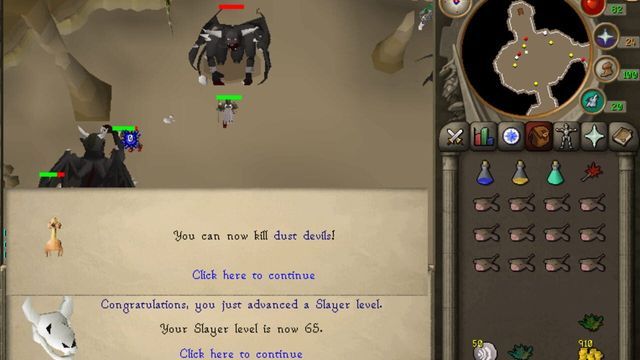
The data we wrote about earlier this year argues the opposite. The MMOs that last don't treat their past as technical debt. They maintain it as a product. Old School RuneScape proved that a frozen-in-time version of a game, developed forward with player approval, can outgrow its modern sibling. Forever is the same bet at a far larger scale: not a museum of 2004, but a 2004 that keeps getting new chapters.
If Blizzard's "most returning players ever" claim is accurate, Forever's real achievement isn't taking players from retail. It's reaching players whom retail had stopped serving.
What to watch
- December 9. The raid unlock is Forever's first retention test. A Twitch and Wikipedia bump that week would show the endgame is pulling people back. A flat line would be a warning.
- The cadence after that. Classic-style games die from running out of content, not from bad launches. The gap between the December raids and the next content drop is the number to watch in early 2027.
- Whether Blizzard publishes a number. "Biggest launch ever" is a strong claim. If retention holds, it'll be tempting for Blizzard to back it with a figure, and it would be the first one in years.
We'll be tracking all of it on the WoW: Forever page.
Sources
- Blizzard: Carve a New Path with World of Warcraft: Forever (Sep 12, 2026)
- Blizzard: BlizzCon 2026 "What's Next" panel recap (Sep 12, 2026)
- Blizzard: The World of Warcraft: Forever beta is now live
- Blizzard: Pre-launch overview and access details (Oct 29, 2026)
- Blizzard: World of Warcraft: Forever Now Live! (Nov 4, 2026)
- Blizzard: Raids unlock on December 9
- @Warcraft on X: "Biggest launch in WoW history" (Nov 6, 2026)
- Holly Longdale on X: new players statement
- Blizzard: Echoes of the Worldcore arrives December 1 (Nov 17, 2026)
- Data: Wikimedia pageviews API and Twitch API, collected daily by MMOStats